Best Platforms to Practice SQL Online in 2026: A Comprehensive Review

 Written by:
Tihomir Babic
All 10 SQL practice platforms we tested against 16 criteria achieve their goal: they will teach you SQL. Find out which ones suit your learning goals.
Editorial note: StrataScratch publishes this comparison and is one of the platforms reviewed. To keep the comparison useful, we evaluate each platform using the same criteria and identify where information comes from our own testing or publicly available sources.
Most “best SQL platform” roundups just repackage homepage copy and call it a review. Then they lick their finger, lift it in the air, and call it a methodology.
We’ll do it differently here: we'll explain the methodology we used, stick to it, and test ten platforms against the same rubrics, from problem quality to pricing to how well each one actually prepares you for an interview.
This guide walks you through what we found. We’ll rank the platforms by their real strengths and gaps. We’ll also point you toward those that fit your specific goals, such as beginner fundamentals, interview prep, or advanced query practice.
Best Places to Practice SQL Online at a Glance
Here’s an overview of ten platforms that made the list, before we go deeper.

How We Evaluated SQL Practice Platforms
Comparing platforms makes sense only if we use the same criteria. We used these 16 criteria to evaluate them.
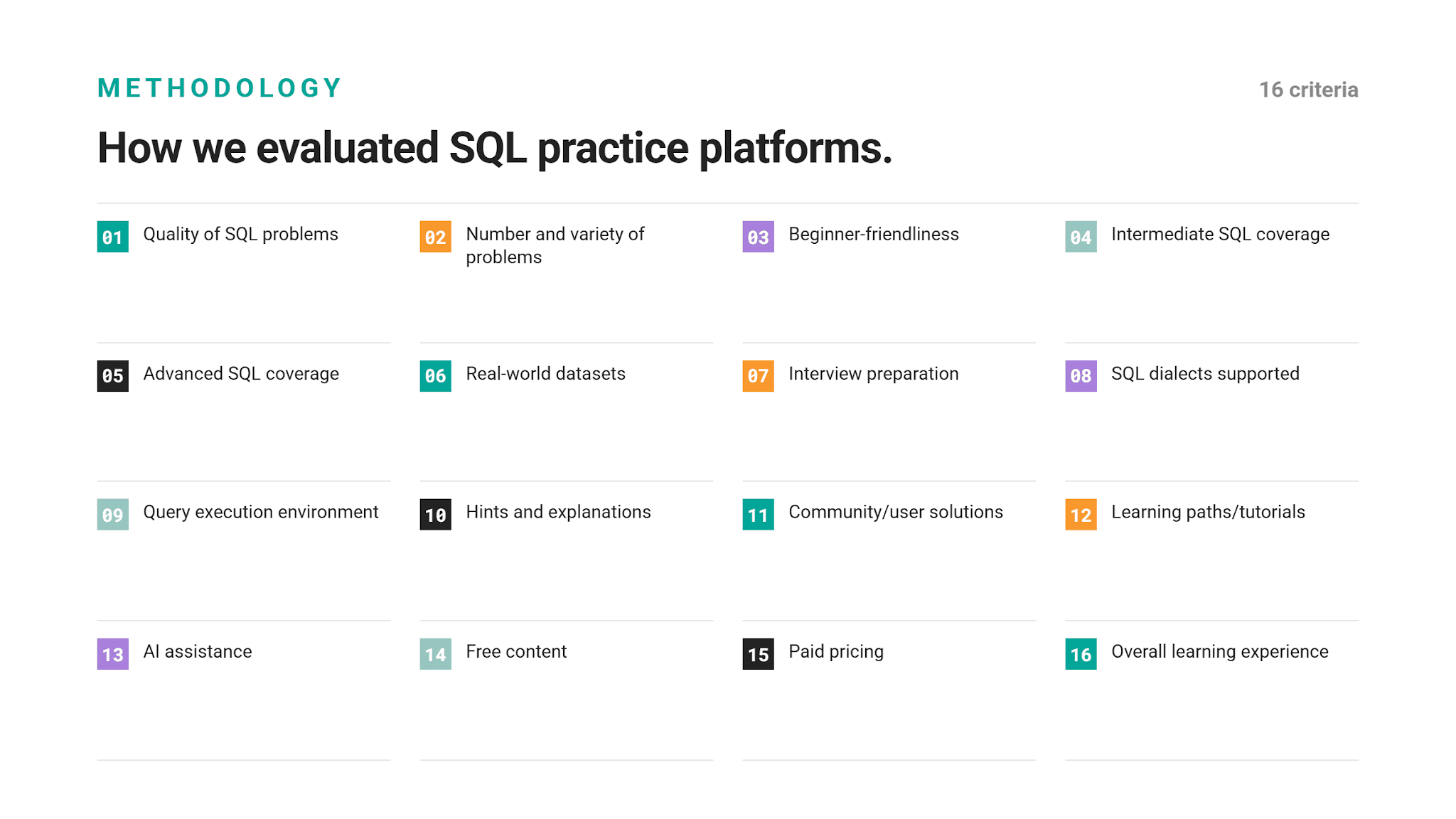
1. Quality of SQL problems: It’s not enough for certain problems to exist. Solving them must teach you something. A well-written problem forces a specific decision. A weak one just checks syntax recall.
2. Number and variety of problems: Raw count of problems matters, but less than range. Ten problems covering ten distinct scenarios beat a hundred variations on the same join any day.
3. Beginner-friendliness: How easy is it to start practicing on the platform for someone who’s never written a SELECT statement? What the onboarding and error messages look like, and whether the first few problems actually teach rather than assume.
4. Intermediate SQL coverage: Joins, subqueries, GROUP BY/HAVING, basic aggregation.
5. Advanced SQL coverage: Window functions, recursive CTEs, query optimization, and the kind of multi-step logic interviewers actually probe for.
6. Real-world datasets: Do the datasets resemble actual, messy data, or are they toy examples like employees and departments with five rows each?
7. Interview preparation: Company-tagged questions, timed practice, and problems sourced from – or closely modeled on – actual interview loops.
8. SQL dialects supported: The dialect you practice in should match what you’ll actually be tested on. How many options does the platform offer?
9. Query execution environment: Does the platform run your query against a real database instantly, or just check your answer against a stored string?
10. Hints and explanations: How much guidance do you get when you’re stuck before the platform just hands you the solution?
11. Community/user solutions: How big and active is the community? Seeing multiple valid approaches to the same problem helps you with learning.
12. Learning paths/ tutorials: Is learning structured so it builds from one concept to the next, or is it an unordered problem bank?
13. AI assistance: Does the platform offer AI-powered hints, code review, or debugging support in the practice flow?
14. Free content: How much of the platform is usable without paying?
15. Paid pricing: What do you get for the paid subscription, and is the cost justified compared to competitors?
16. Overall learning experience: Interface quality, pacing, and whether the platform makes you want to come back tomorrow.
Scoring Method
We scored each criterion from 1 to 5. These are not school grades, where 1 means “done poorly”. It often means the platform simply doesn’t offer that feature at all.
You should read each score in the context of what the platform is actually trying to be, not as a standalone judgment.
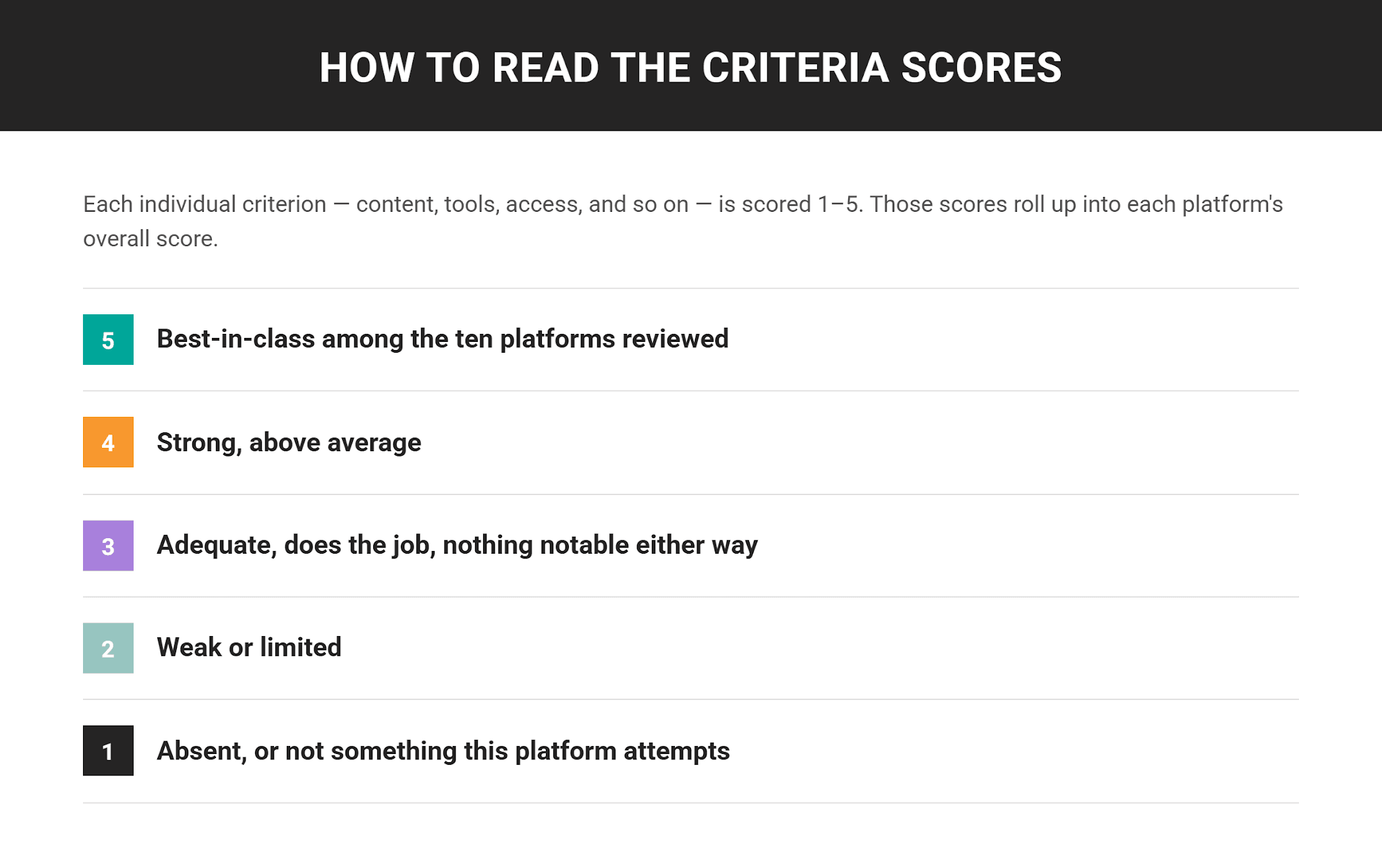
Overall grade is a simple average across all 16 criteria, paired with a descriptive band.

Which SQL Practice Platform Should You Choose?
Not one platform is best for everything. What’s “best” entirely depends on what you’re optimizing for.
Here’s our pick for nine common goals.

For Complete Beginners
Platform: SQLBolt or SQLZoo
Reason: Both strip away everything except the core syntax, with instant feedback and no confusing interview framing to worry about.
For SQL Interview Preparation
Platform: StrataScratch
Reason: Company-tagged questions sourced from actual interviews, four supported dialects (PostgreSQL, MySQL, SQL Server, and Oracle), and problems that mirror what you’ll actually see in interviews.
For Data Analyst Interviews
Platform: StrataScratch, with DataLemur as a strong secondary
Reason: Both are heavy on business-context queries, like funnels, cohort retention, revenue breakdowns, etc.
For Data Science Interviews
Platform: StrataScratch
Reason: It’s one of the few platforms that pairs SQL questions with other data science skills (product sense, statistics, ML), instead of treating SQL as an isolated skill.
For Advanced SQL Practice
Platform: LeetCode or StrataScratch
Reason: Both have plenty of problems built around advanced SQL topics, such as window functions and recursive CTEs. LeetCode is ahead on raw volume; StrataScratch is ahead on real-world framing.
For Practicing Real-World SQL
Platform: StrataScratch or sql-practice.com
Reason: StrataScratch sources problems from actual companies’ interviews, paired with constructed but realistic datasets modeled on the business scenario. The sql-practice.com platform runs a single believable business schema you can query freely.
For Free SQL Practice
Platform: SQLZoo, SQLBolt, or PostgreSQL Exercises
Reason: Of all the platforms, those three are the most usable without ever hitting a paywall. However, none cover interview-style or advanced problems as deeply as paid platforms.
For Learning PostgreSQL
Platform: PostgreSQL Exercises
Reason: It’s the only platform built around one dialect exclusively. Every exercise leans into Postgres-specific features rather than generic SQL.
For Structured SQL Courses
Platform: DataCamp
Reason: Provides a guided curriculum with video instructions rather than a raw problem bank.
Detailed Reviews of the Best Platforms to Practice SQL Online
We’ll now explore all ten platforms in detail.
StrataScratch
StrataScratch is built specifically around data science and data analyst interview preparation, not general programming practice. Questions are pulled from real interview questions at named companies: Amazon, Meta, Google, Uber, Stripe, and 80 others.
This review is based on our own hands-on use of the platform, since StrataScratch is the site publishing this comparison.
Review & Scoring of the Established Criteria


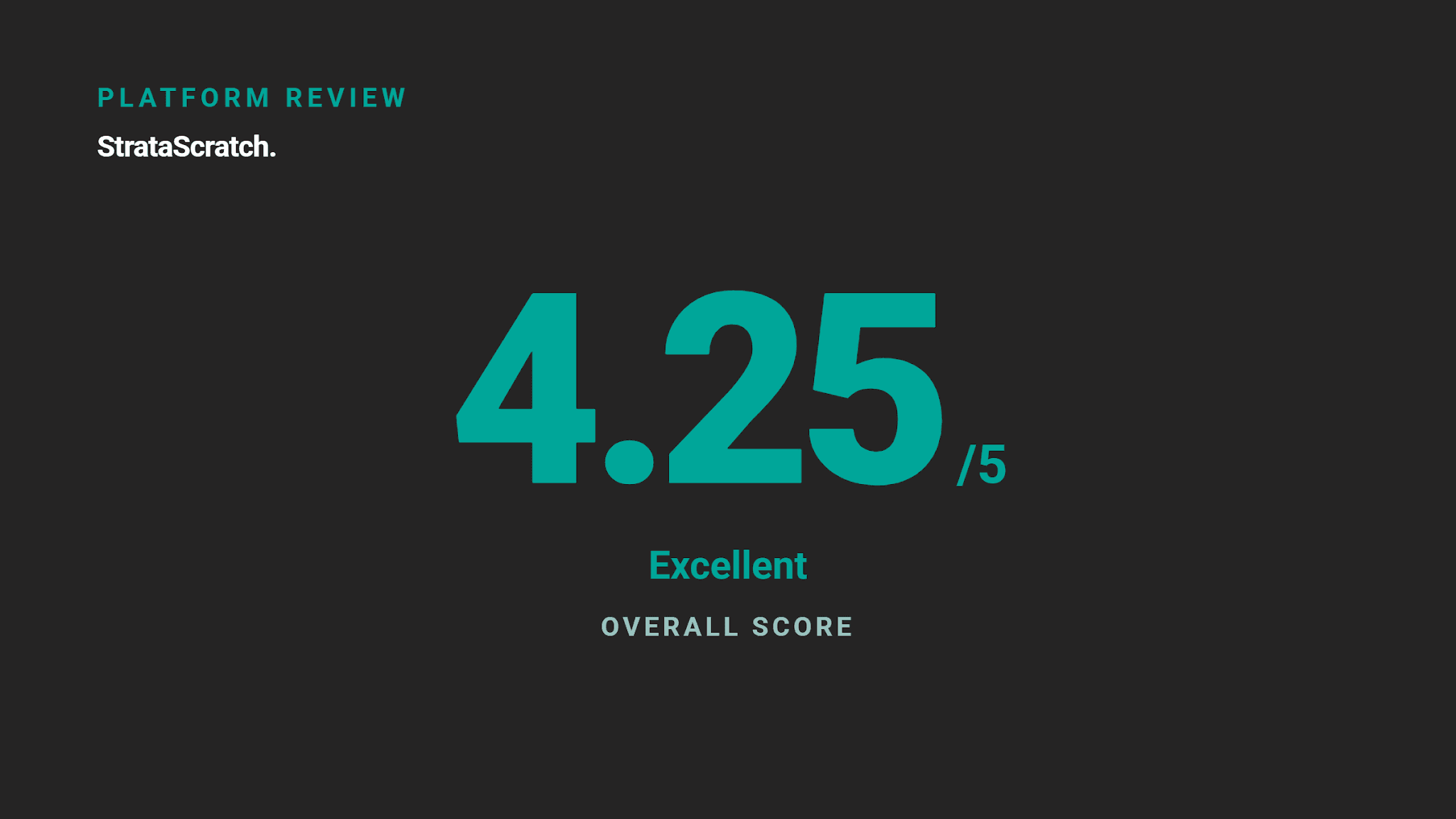
Overall Score
Bottom Line
The AI tooling goes further than any other platform on the list. However, it’s split across Free and Premium in a way that’s easy to underestimate until you hit the wall (50 free AI credits/month, no AI Guidance or Mock Interviews without upgrading).
This is the platform to pick if the AI-driven interview simulation and company-tagging are what you actually want to use, not just for raw volume of questions to grind through.
LeetCode
LeetCode is primarily a general coding-interview platform. Algorithms and data structures make up most of its +4,000 problems. There is, however, a dedicated “Database” category for SQL.
This review is based on public documentation, pricing pages, and aggregated user reports, not a paid account.
Review & Scoring of the Established Criteria


Overall Score

Bottom Line
LeetCode has the largest community and most battle-tested execution environment on this list. But the SQL bank is comparatively small and schema-simple next to platforms built specifically around data-role interview preparation.
It’s better as a supplement to algorithmic interview preparation than as your primary SQL source.
HackerRank
HackerRank is primarily known today as an employer-facing technical assessment tool. However, it has a SQL practice section that individual users can use for free, along with skill certifications.
This review, too, is based on public documentation and aggregated user solution repositories, not a paid account.
Review & Scoring of the Established Criteria


Overall Score

Bottom Line
The certification badges and fully free access make this a solid platform for beginners wanting proof of fundamentals, but it’s weak on interview-specific preparation, advanced coverage, and any form of AI or community support.
DataLemur
DataLemur is a narrowly focused SQL and data-interview platform. It was built by Nick Singh (author of Ace the Data Science Interview), positioned specifically around FAANG-style interview questions.
This review is based on public documentation, third-party comparisons, and pricing pages, not a paid account.
Review & Scoring of the Established Criteria


Overall Score

Bottom Line
The hints and solutions depth and company-specific interview guides are genuinely strong. Also, the price undercuts LeetCode meaningfully. However, the smaller question count, narrower dialect support, and complete absence of AI tooling put it behind StrataScratch.
DataCamp
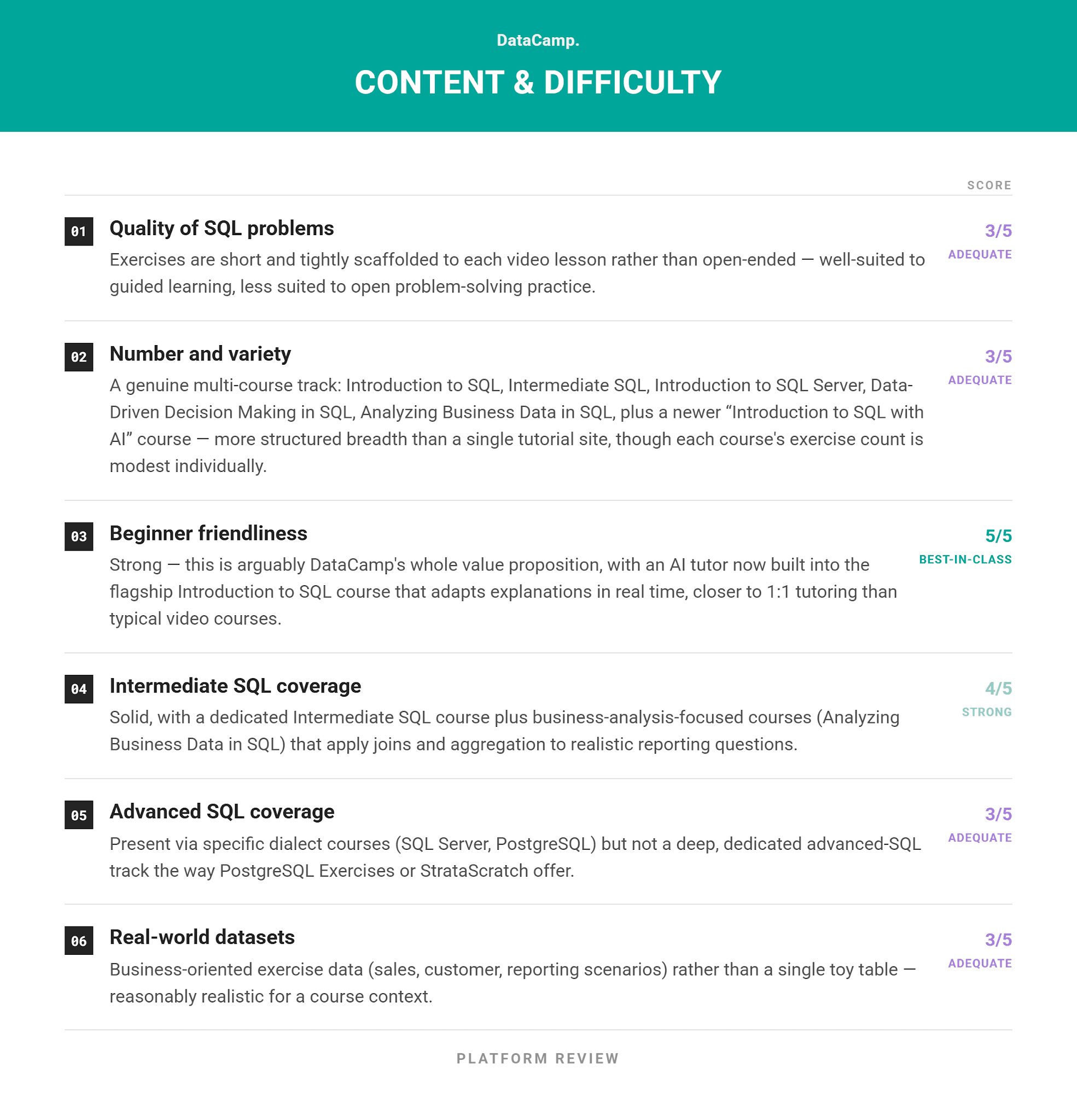
DataCamp is a structured, video-and-exercise course platform. It’s the only one on this list that’s built around guided instruction, not a raw problem bank. SQL is one of several tracks (alongside Python, R, and AI), with courses feeding into certification tracks like Associate Data Analyst and Associate Data Engineer.
This review is based on public course pages, third-party course rankings, and pricing information, not a paid account.
Review & Scoring of the Established Criteria


Overall Score

Bottom Line
The best structured, video-led course platform on the list, especially since it’s now differentiated by real-time AI tutoring built into the lessons themselves. However, it’s not a practice-problem bank, but a course platform; it pairs better with something like StrataScratch or LeetCode than it replaces them.
SQLZOO
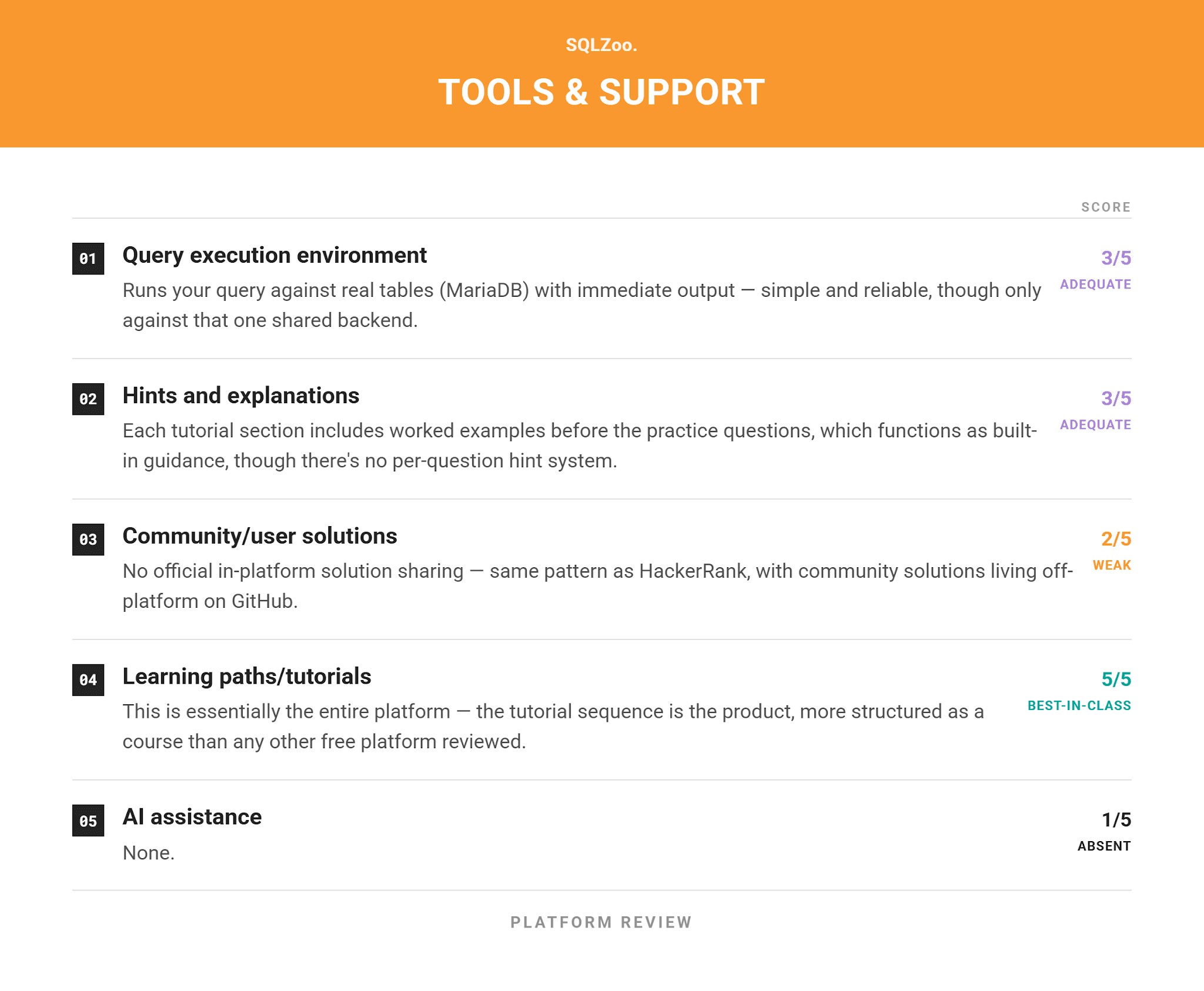
SQLZoo is a long-running, free, interactive tutorial platform. There are no company-tagged interview questions, but there are structured, quiz-like SQL tutorials starting from first principles.
This review is based on public tutorial content and community-documented solutions, not a paid account (there is no paid tier).
Review & Scoring of the Established Criteria


Overall Score

Bottom Line
The strongest free tutorial for beginners, with real (if simple) datasets. There is even some window-function coverage you probably don’t expect from it.
Not a fit once you need company-tagged interview practice or a large problem bank.
PostgreSQL Exercises
PostgreSQL Exercises is what the name says: a PostgreSQL-only practice platform. It uses a single dataset built around a fictional country club’s members, facilities, and bookings.
It’s designed as a companion to a SQL book or the official PostgreSQL documentation rather than a standalone course.
This review is based on public site content; there’s no paid tier.
Review & Scoring of the Established Criteria


Overall Score

Bottom Line
The best free platform on this list for PostgreSQL-specific advanced practice. However, it’s a wrong starting point for a true beginner and offers nothing for interview prep.
sql-practice.com
sql-practice.com is a free, browser-based SQL practice site built around two SQLite datasets – a hospital database (patients, admissions, doctors) and a Northwind-style business database – with a structured set of Easy/Medium/Hard challenges alongside a reference-style learning resources sidebar.
This review is based on public site content and third-party solution repositories; there’s no paid tier.
Review & Scoring of the Established Criteria


Overall Score

Bottom Line
A solid, distinctive-feeling free option thanks to the hospital dataset, which is better than the generic employees table most free sites reuse. However, the platform is thin on hints, advanced coverage, and anything beyond the practice questions themselves.
SQLBolt
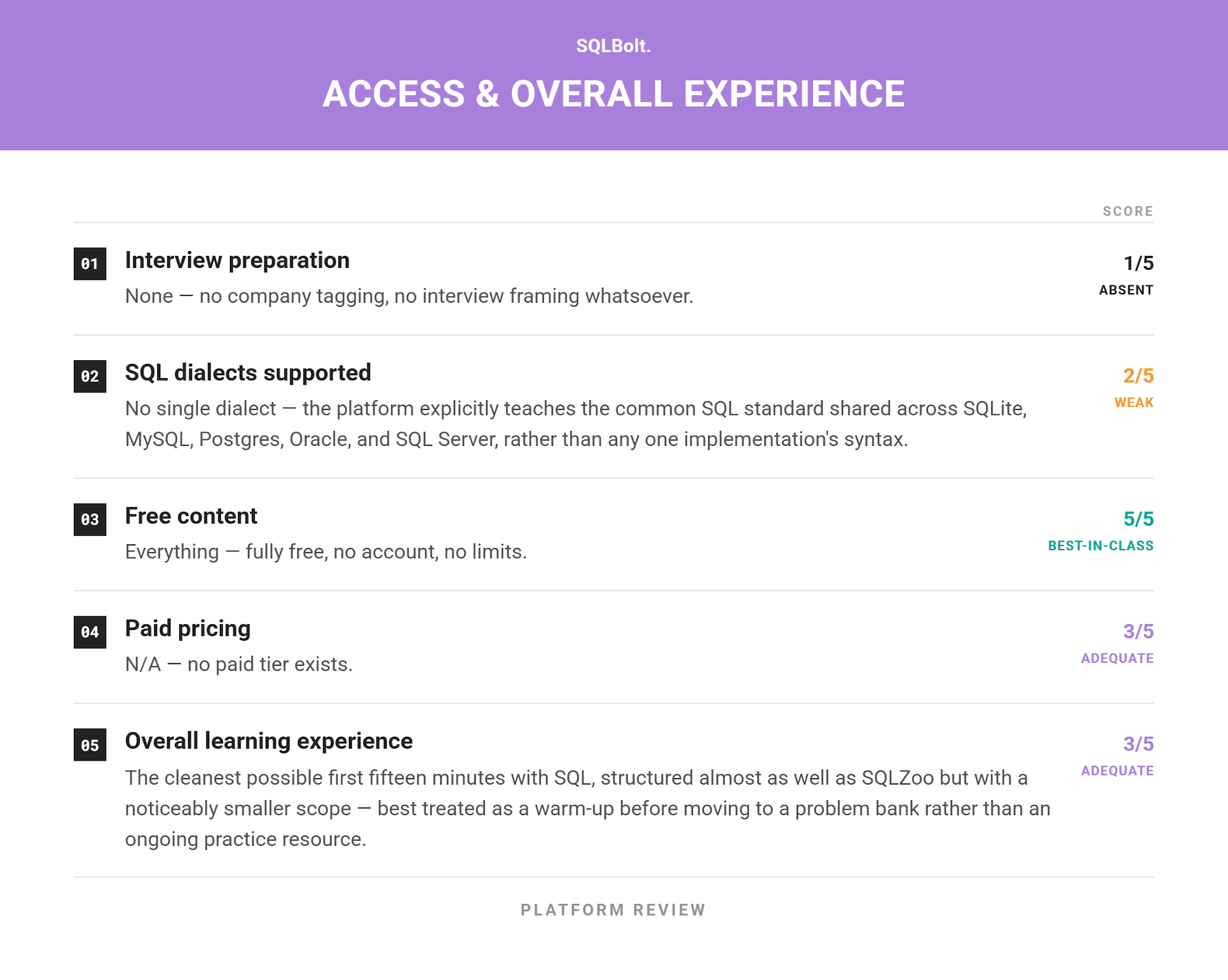
SQLBolt is a minimal, free interactive tutorial. It uses a single movie dataset to cover SQL fundamentals, entirely in-browser. This makes it closer to a well-made coding tutorial than a practice platform.
This review is based on public tutorial content; there’s no paid tier to speak of.
Review & Scoring of the Established Criteria


Overall Score

Bottom Line
This is the best platform for someone who has genuinely never written SQL. However, there’s nothing more than that to it. Once you finish ~18 lessons, there’s no deeper content to grow into, and you’ll need to move elsewhere for anything beyond fundamentals.
W3Schools SQL
W3Schools SQL is a free, reference-style tutorial that many developers use for quick syntax lookups. The syntax documentation is paired with a lightweight exercise set and an optional paid certification.
This review is based on public tutorial and certification pages; there’s no practice-problem subscription here.
Review & Scoring of the Established Criteria


Overall Score

Bottom Line
A platform genuinely useful as a syntax reference, and the certification has some resume value for its low cost. However, it’s the weakest platform on the list if what you actually need is practice-driven skill-building.
SQL Practice Platforms Compared by Features
Here’s a comparison of all platforms across all 16 features. We’re using checkmarks to mark Strong (4/5) or Best-in-Class (5/5) on that criterion. A blank means Adequate or below, not necessarily absent.
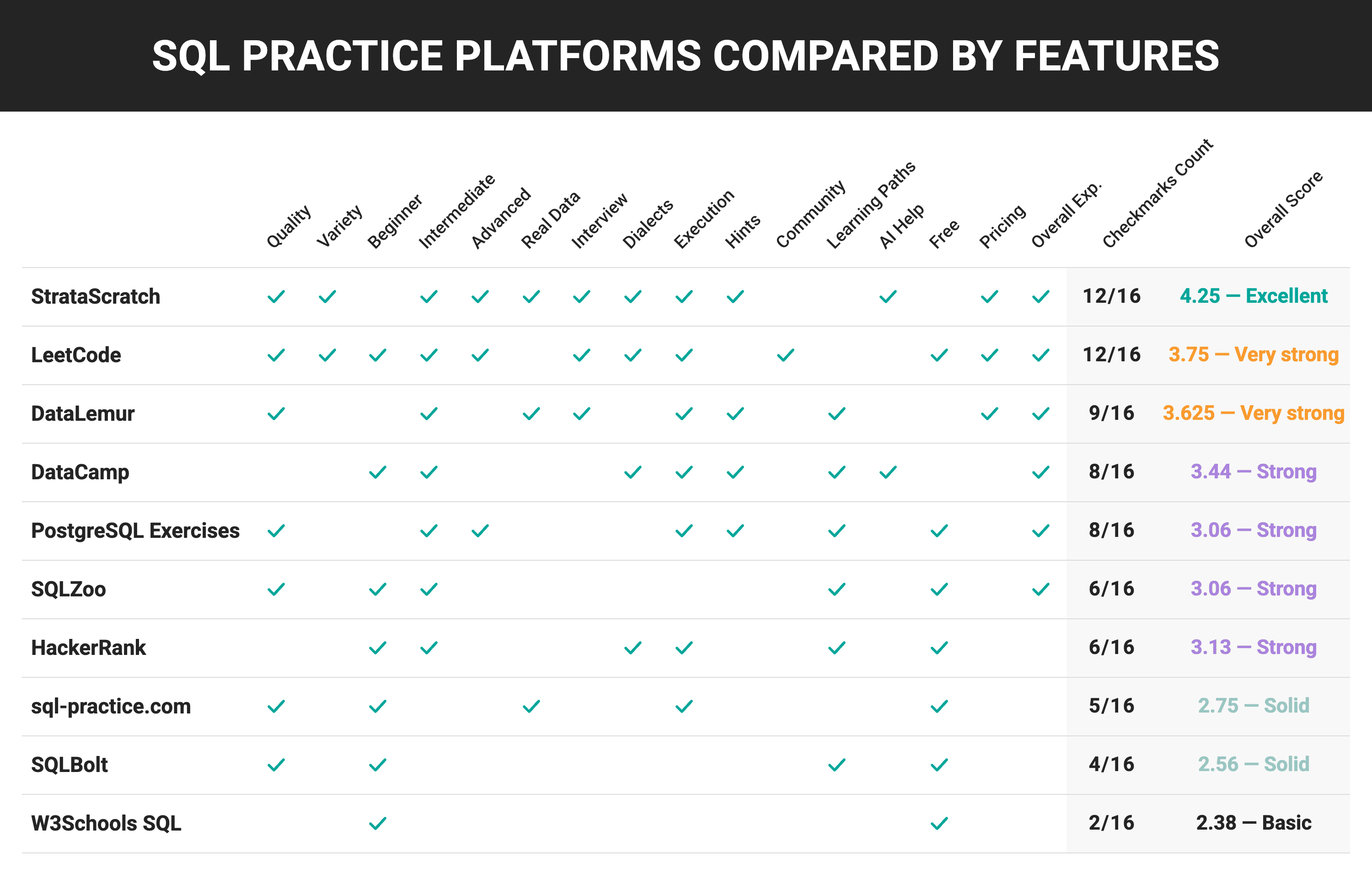
StrataScratch and LeetCode both lead with 12 of 16 checkmarks. However, StrataScratch’s higher average (4.25 vs 3.75) still separates them. DataLemur is a clear third at 9. From there, DataCamp and PostgreSQL Exercises tie at 8, before a real drop to SQLZoo (6) and the bottom cluster of the platforms.
Free vs Paid SQL Practice Platforms
Five of the ten platforms we reviewed here are entirely free, with no paywall of any kind. The other five use a freemium model – free tier plus paid upgrade – with meaningfully different amounts gated.

If You Want Zero Cost
SQLZoo, SQLBolt, PostgreSQL Exercises, and sql-practice.com don’t ask for any payment. HackerRank belongs here, too, as it doesn’t require payment for individual use; paid tiers are enterprise recruiting products. Pick between them based on which teaching style and dataset fit you.
We would recommend SQLZoo and SQLBolt for total beginners, PostgreSQL Exercises for advanced Postgres-specific practice, sql-practice.com for a more distinctive real-world schema, and HackerRank if a résumé-ready skill certification matters to you.
If You’re Weighing a Subscription
The four freemium platforms differ a lot in what the free tier gets you before you hit a wall.
StrataScratch’s free tier is the most generous in absolute terms: 75+ full questions with solutions, not just previews. DataCamp is the most restrictive; you get one chapter, nothing else.
Price-to-content is also uneven. DataLemur is the cheapest ($5/month, effective at $60/year) but has the smallest paid catalog, and the free tier only lets you run code, not submit it, and locks out solutions, discussion, and other users' submissions.
StrataScratch’s $139/year (about $11.58/month) unlocks the largest catalog plus the most AI tooling of any paid platform on the list.
Free Doesn’t Mean Equivalent Value
When we say something is free, it doesn’t mean you get the same value as any paid platform, but for free. For example, SQLZoo’s tutorials are excellent for learning fundamentals but won’t prepare you for a company-tagged interview question the way a paid StrataScratch or DataLemur subscription will.
So, the comparison isn’t really about “free vs.paid”. It’s whether a fully free platform or a free tier of a paid platform actually covers what you personally need.
SQL Practice Platforms for Beginners vs Advanced Users
Beginner friendliness and advanced coverage are almost inversely related across this list: the platforms best suited to a total newcomer are typically lacking real depth for advanced practice, and vice versa.

For Absolute Beginners
Four platforms are best-in-class in onboarding.
SQLBolt and SQLZoo teach from zero with no account needed. HackerRank turns fundamentals into a gamified certification path. DataCamp wraps beginner content in guided video with a real-time AI tutor.
You will quickly outgrow SQLBolt and SQLZoo; the former has no advanced content at all. DataCamp at least has a path forward into intermediate and dialect-specific courses.
For Advanced Practice
Three platforms score Strong or better: StrataScratch, PostgreSQL Exercises, and LeetCode.
StrataScratch has the deepest hard-level content, with real window–function and multi-CTE depth.
PostgreSQL Exercises is the only free platform with dedicated window-function and recursive-query content.
LeetCode’s hard tier adds real volume, though its schemas stay closer to interview-puzzle style than business-realistic.
All other platforms top at Adequate (3).
How to Bridge the Knowledge-Level Gap
StrataScratch and PostgreSQL Exercises – the two strongest advanced options – are also two of the weakest for total beginners.
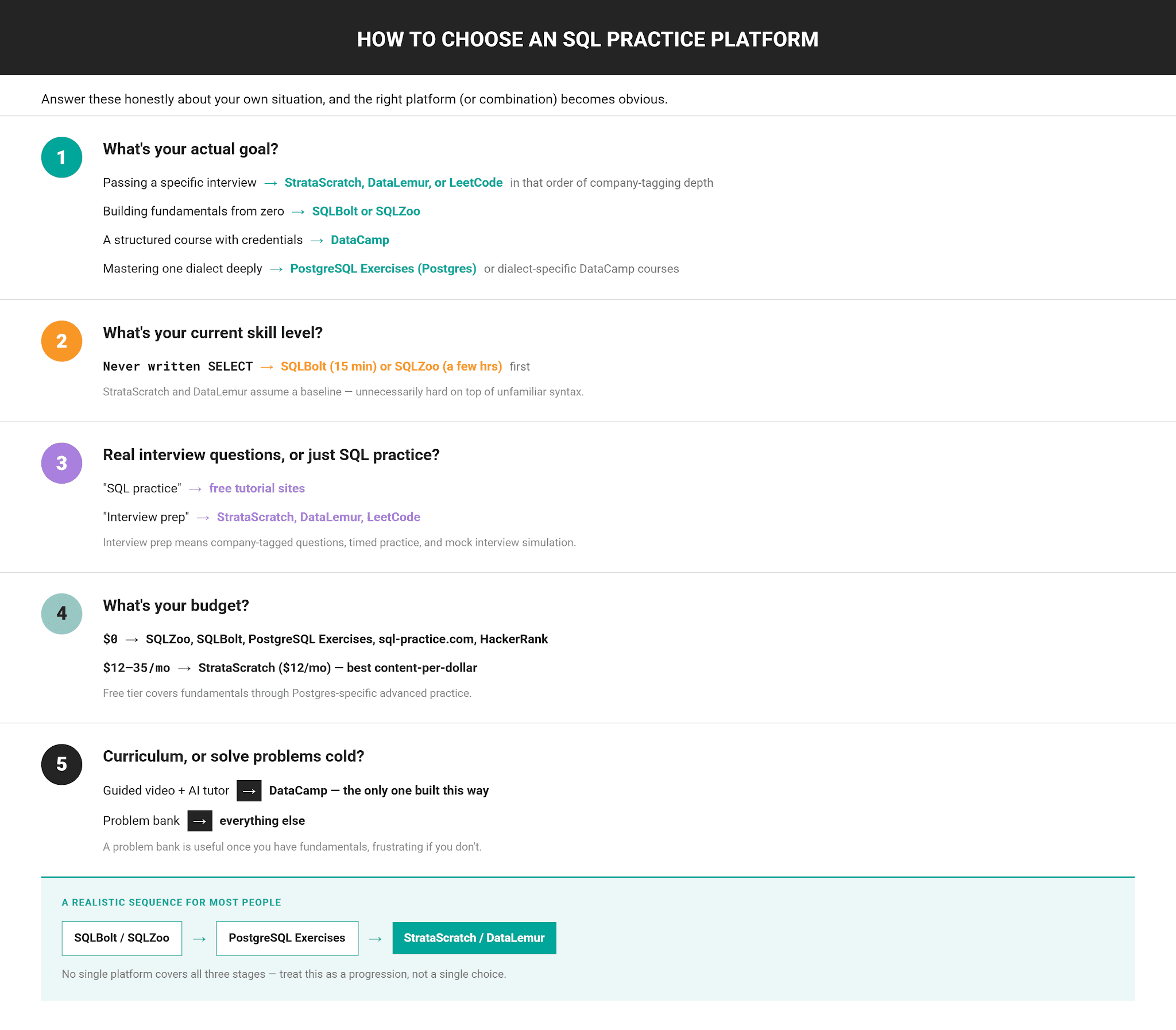
So, if you’re really starting from zero but want to end up doing advanced SQL, then the approach we recommend is sequential, not single-platform: start with SQLBolt or SQLZoo for fundamentals, then move on to StrataScratch or PostgreSQL Exercises once you’ve outgrown them.
No platform on our list is genuinely excellent at both ends of that spectrum simultaneously.
SQL Practice Platforms for Interview Preparation
Interview preparation is the single most polarized criterion in this whole comparison. Three platforms score at the top, while the other seven score two or below.
Here, there’s no middle ground: the platform is either excellent for interview preparation or not suitable for that at all.

StrataScratch and DataLemur both hit company tagging and dedicated interview guidance, but StrataScratch adds an AI Mock Interview tool (timed sessions, AI feedback, progress tracking) that DataLemur doesn’t have – a real differentiator if simulated practice under time pressure matters to you specifically.
DataLemur’s advantage is its company-specific interview guides, which go deeper into what a particular company’s interviews look like.
LeetCode is not built around interview simulation the same way. However, its strength is its community size, which means real interview questions from major companies tend to surface in discussion threads even without paying for the official company-tagged list.
Example: What Practicing SQL on These Platforms Actually Looks Like
To give you an idea of the differences between the platforms in practice, we’ll show you how practicing one concept looks on StrataScratch, DataLemur, and SQLZoo.
The underlying concept is GROUP BY and aggregation, but framed completely differently.
StrataScratch
On StrataScratch, there’s the “Number of Custom Email Labels” question.
Number Of Custom Email Labels
Find the number of occurrences of custom email labels for each user receiving an email. Output the receiver user id, label, and the corresponding number of occurrences.
It gives you two tables – google_gmail_emails and google_gmail_labels – with schema and data preview available on the platform.
It asks you to output the receiver’s user ID, the label, and how many times each label was used on emails they received, restricted to labels starting with “custom”.
The question is framed around a real product scenario – email organization at Google – with difficulty and company context visible before you start.
The solution requires a join before the aggregation. You write the code in the code editor where you can run it, check your solution against the actual question datasets, or ask AI for help if you get stuck.
As for the output, you can also see what’s expected by clicking on the Expected Output button.
Once you run the code, the code editor shows the output.
After you solve the question, see the official solution or the solutions from users. Even though you solved the question, your approach might differ from others’. You can discuss those differences with other users (and StrataScratch admin) in the “Discussion” section.
In addition, there is a “Resources” tab, where you can find StrataScratch articles for exploring the question-related topics.
LeetCode
On LeetCode, the “Customer Placing the Largest Number of Orders” problem gives you a single Orders table with two columns: order_number and customer_number. No company is named anywhere on the platform.
It asks for the customer who placed the most orders.
The schema is deliberately minimal, and you’re given an example of the first few rows and what the solution is. The question is solvable against a single table with no join; you write the code in the code editor.
SELECT customer_number
FROM Orders
GROUP BY customer_number
ORDER BY COUNT(*) DESC
LIMIT 1;
SQLZoo
On SQLZoo, the “SUM and COUNT” tutorial covers what the previous two platforms test in interview questions. The tutorial walks you up to grouping gradually. Before you ever see a GROUP BY, you’ve already answered simpler questions against the same world table (total population, GDP of Africa).
Only then does it introduce “For each continent, show the continent and number of countries”, so you submit this.
SELECT continent,
 COUNT(name)
FROM world
GROUP BY continent;
This is deliberately the simplest possible GROUP BY, as the point is to isolate the one new concept. It’s taught in isolation, with no join and no company framing.
What the Comparison Illustrates
We used the same SQL clause – GROUP BY plus an aggregate – to demonstrate how the surrounding structure differs.

None of these are “harder” SQL in isolation. The difference is how much real-world specificity and structural complexity each platform layers on top of the same core clause.
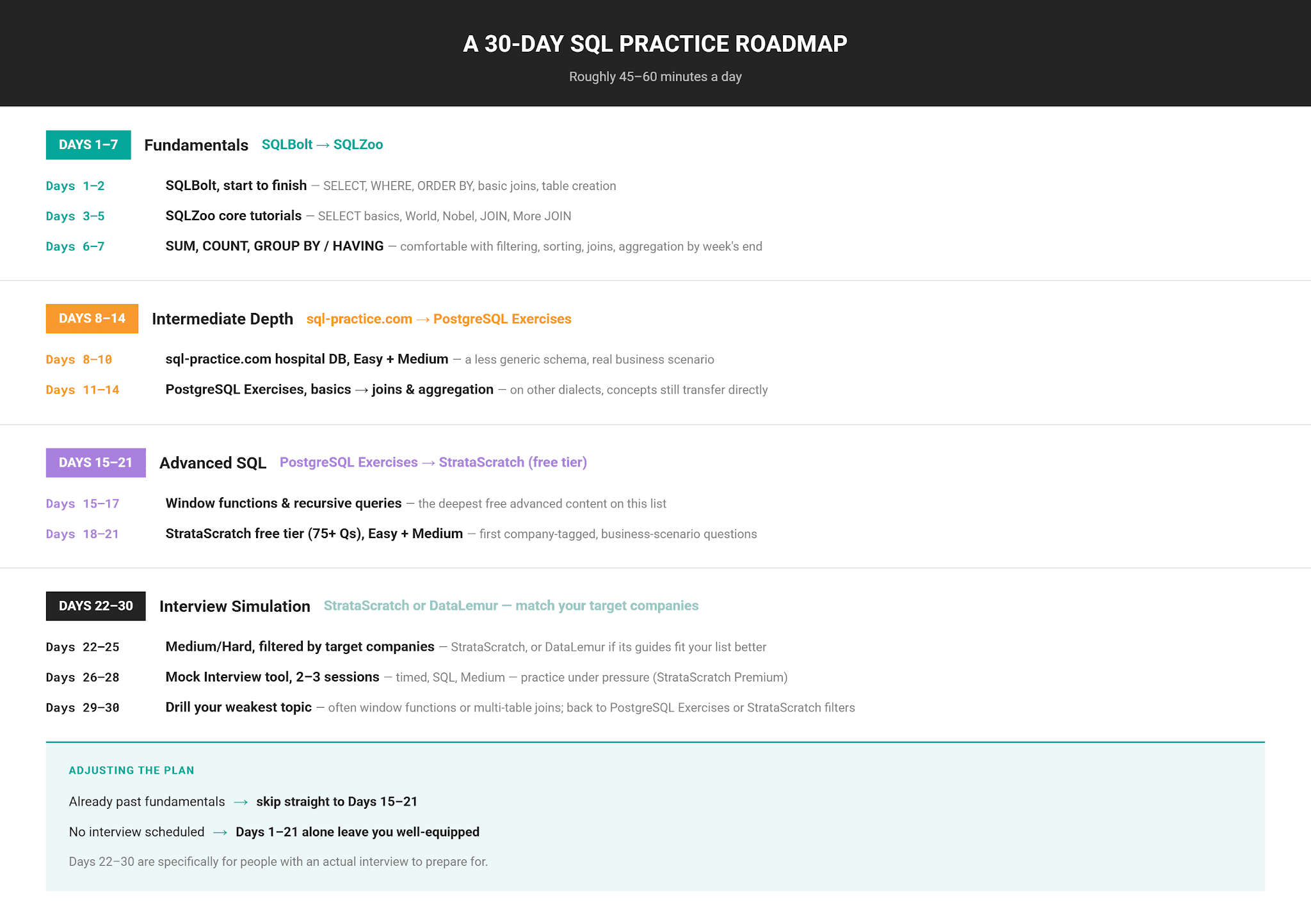
A 30-Day SQL Practice Roadmap
This is the sequence outlined above, compressed into a specific day-by-day plan.
Conclusion
No such thing as the best SQL practice platform exists. The best choice depends on what you are trying to achieve.
In our analysis, StrataScratch scored highest in this comparison (4.25/5). Its strengths are company-tagged questions, the largest number of advanced SQL problems, and extensive AI tooling: Mock Interviews, Debug-AI-Code, and concept grading. The editorial note at the top of this article stands: we built and scored this comparison, and StrataScratch is one of the platforms in it. We built this platform on our experience and on what we think will give the best value to people wanting to learn and practice SQL and be ready for job interviews. That still doesn’t mean that StrataScratch is the absolute best for everybody.
If you’re a total beginner, SQLBolt or SQLZoo is our recommendation.
If you specifically need PostgreSQL depth, then PostgreSQL Exercises should be your choice.
For structured video learning over raw problems, DataCamp is built for that in a way no other platforms are.
Is your budget zero? There are four fully free platforms on our list plus HackerRank; they cover fundamentals via advanced dialect-specific practice without asking for a cent.
For the most comprehensive learning, combining several platforms is ideal. Revisit the 30-day roadmap for a suggested learning sequence.
FAQ
1. What is the best website to practice SQL?
It depends on your goal. For interview preparation specifically, StrataScratch is the best. It scored highest in this comparison (4.25/5) thanks to company-tagged questions, AI-driven mock interviews, and the deepest advanced-SQL bench.
If you’re a beginner, SQLBolt or SQLZoo are better starting points.
There’s no single “best” website. It all depends on what you’re trying to achieve.
2. Where can I practice SQL for free?
SQLZoo, SQLBolt, PostgreSQL Exercises, and sql-practice.com are fully free.
HackerRank is effectively free for individual practice. Its paid tiers are enterprise recruiting products, not consumer content.
Even paid platforms have a freemium tier. On StrataScratch, it includes 75+ full questions with solutions, not just previews. LeetCode’s free tier covers most Easy and many Medium problems with no time limit. Also, both DataLemur and DataCamp offer limited free access if you want a taste before subscribing.
3. Where can I practice SQL for interviews?
StrataScratch, DataLemur, and LeetCode are the three platforms built around interview preparation with company-tagged questions and, in StrataScratch’s case, a dedicated AI Mock Interview tool.
4. What is the best SQL practice platform for data analysts?
StrataScratch and DataLemur. They both weigh toward business-context queries – funnels, retention, revenue – over pure algorithmic puzzles, matching what data analyst interviews actually test.
5. What is the best SQL practice platform for data scientists?
StrataScratch. Specifically, because it pairs SQL questions with the surrounding data science skills – statistics, probability, product sense – rather than treating SQL as an isolated skill.
6. Is LeetCode good for SQL practice?
Yes. It’s particularly because of its execution environment (runs against a real backend instantly) and its large community where you can find alternative solutions per problem. However, its SQL-specific bank (+300 Database-tagged problems) is smaller than StrataScratch’s 600+, and schemas skew toward clean, interview-puzzle style rather than business-realistic.
7. Is HackerRank good for SQL practice?
Yes, but only for fundamentals and skill certification. Its three-tier certification system (Basic, Intermediate, Advanced) and fully free access make it a solid stop for beginners wanting a resume-ready credential.
It’s weaker on interview-specific prep, advanced coverage, and community or AI support.
8. What are alternatives to LeetCode for SQL?
StrataScratch offers a much larger dedicated SQL bank (600+ vs ~196) with business-scenario framing.
DataLemur offers narrower but more interview-realistic questions at a lower price.
HackerRank is a free, certification-driven alternative for fundamentals rather than advanced practice.
9. What are alternatives to DataLemur?
StrataScratch covers similar ground (company-tagged, business-scenario SQL) with a larger question bank and additional AI tooling DataLemur doesn’t have.
LeetCode is a broader alternative if you want algorithmic practice alongside SQL specifically.
10. Is StrataScratch good for SQL practice?
Yes. Its company-tagged questions are real interview questions; it has the largest number of advanced SQL problems, and AI tooling (Mock Interviews, Debug-AI-Code, concept grading) that no competitor matches.
Its main limitation is that it isn’t built primarily for absolute beginners.
11. Can beginners use StrataScratch?
Yes. There are Easy questions and a free tier to start with. However, note that the platform isn’t built primarily for someone who’s never written SQL.
A true beginner is generally better served starting with SQLBolt or SQLZoo first, then going back to StrataScratch after you achieve a certain SQL baseline.
12. How long does it take to learn SQL?
A few hours to a couple of days on SQLBolt or SQLZoo is enough to solve basic SELECT/WHERE/JOIN queries comfortably.
Reaching interview-ready comfort with joins, aggregation, subqueries, and window functions realistically takes several weeks of regular practice.
13. How many SQL problems should I solve?
There’s no fixed number. It depends more on the range of concepts (joins, aggregations, subqueries, window functions) that questions cover, rather than a specific question count.
As a rough benchmark, working through a few dozen problems per difficulty tier (Easy, Medium, Hard) on a platform like StrataScratch or LeetCode is a reasonable target before an actual interview.
14. Which SQL dialect should I practice?
Practice a dialect the company you’re interviewing with actually uses. You can often find that out by checking the job posting or asking your recruiter.
If you don’t know, PostgreSQL and MySQL are the safest bets. They are the two most commonly tested dialects. However, whichever dialect you choose, rest assured that the underlying logic transfers almost entirely between dialects.
15. Should I learn PostgreSQL or MySQL?
Either is a reasonable choice.
The core SQL, such as joins, aggregations, and subqueries, is nearly identical between them. The differences show up mainly in specific functions and syntax details.
16. How do I practice advanced SQL?
PostgreSQL Exercises (free) and StrataScratch (paid). They both have genuine window-function and multi-step query content. PostgreSQL Exercises additionally covers recursive CTEs, a topic most other platforms skip entirely.
17. How do I practice SQL without installing a database?
None of the platforms we reviewed require installing a database.
StrataScratch, LeetCode, SQLZoo, SQLBolt, sql-practice, and PostgreSQL Exercises all run entirely in-browser.
Share